Scenario one: you put all your questions into one long message.
The result
AI sends you a long answer, too. It explains a little about each question, but none of the explanations goes deep enough.
00 /Motivation
In a 2025 study of nearly 1,000 high school students, a University of Pennsylvania research team found that a standard GPT assistant improved practice performance. But once AI was removed, students scored 17% lower than the control group on an independent exam.
Read the studyWhat worries me: people hand a problem straight to AI and let it take care of it. As AI becomes more capable, it really can get the job done.
But taking this shortcut may leave our own abilities standing still: we’ve outsourced our thinking!
When we take on a problem, here is how I think we should approach it:
That way, AI becomes our assistant rather than a substitute for our thinking. And in the process, we also improve our own abilities.
So why don’t more people do this? Here is what I think: the linear conversations common in today’s agents and chatbots were not designed around supporting deeper thinking. Take a look at the example below:
The result
AI sends you a long answer, too. It explains a little about each question, but none of the explanations goes deep enough.
The result
After several rounds of conversation, you finally understand the first question. By then, you have completely forgotten your second and other questions.
Our solution
ThinkDeepWide turns your conversation into a tree, so you can return to any earlier exchange.
This way, you can ask follow-up questions about one topic over several rounds and keep thinking it through.
Once you have worked through one question, you can click an earlier tree node, return to that exchange and ask your other questions.
While AI answers your first question, you can open other branches for your second and third.
Different branches can reply at the same time, so you don’t have to wait.
ThinkDeepWide optimizes context-cache reuse across branches to reduce repeated processing of the same conversation, so your wallet doesn’t go up in flames.
01 /See how you can use it
02 / Interactive product walkthrough
03 /This is an agent, not just a chatbot.
This product is not a simple chatbot.
You can even use your existing Codex/Grok coding plan, without buying extra tokens.
You can ask it to read local files, edit code, run experiments and save a document of your discussions in your project.
“Read those papers I saved earlier.” You can ask questions about your files, have it organize your material or write a document.
“Write and run some code based on what we just discussed.” You can see what it runs and the results, then ask it to investigate or make changes.
You can ask it to search the web, read sources and analyze what it finds alongside the files in your project.
After it edits your code, you can inspect the additions and deletions and decide which changes to keep.
You can work locally or connect to a Linux host over SSH and let it run tasks in your remote environment.
You can use Skills to save your working methods and MCP to connect other tools and services, so it can work your way.
You can organize tasks by project, choose models and reasoning effort, and follow the progress and results of delegated tasks.
You connect your own model accounts. When it needs permission or a decision from you, it asks and waits for your confirmation.
Connect your existing Codex / Grok account. You can start with a project on your computer or connect to your SSH host.
macOS first. Windows is coming in several days. Linux is supported as an SSH host only.
ThinkDeepWide 0.42.4
This build uses a development signature and has not been notarized by Apple.
On first launch, allow it to open in System Settings → Privacy & Security.
A conversation tree does look simple. But drawing the tree is only the first step. When you branch from the same exchange to ask several questions, a cache miss can make the model process the same earlier conversation again—and you pay for that repeated work. To address this, we have substantially reworked the agent engine to handle context and cache reuse across branches.
We have also put a lot of work into the UI specifically for thinking deeply. You can give different questions their own branches, keep following one question, then return to an earlier node to explore another. We want to make it easier for you to think things through, because it makes sense to hand the execution over to AI only after you have worked out what you want to do.
So I want to build a product where you lead the thinking and make the judgments, while AI supports you with answers and explanations, then puts the ideas you have thought through into practice. We want every problem you solve to be an opportunity to improve your own abilities.
We will keep following upstream updates from Codex / Grok Build and bring them over after checking compatibility, so you can get their latest features as promptly as we can.
There will be more usage because you are asking AI to answer more questions. But branching should not make you pay to process the same earlier conversation over and over. That is the context-cache reuse we optimize, to help keep your wallet from going up in flames.
Cache hits still depend on the model, changes to the context and the provider’s caching rules. We will not tell you that unlimited branches are free or promise a fixed percentage of savings.
Yes. While AI is still replying, you can return to an earlier node and open another branch for your second or third question. Several branches can reply at the same time, so you do not have to wait for the first one to finish.
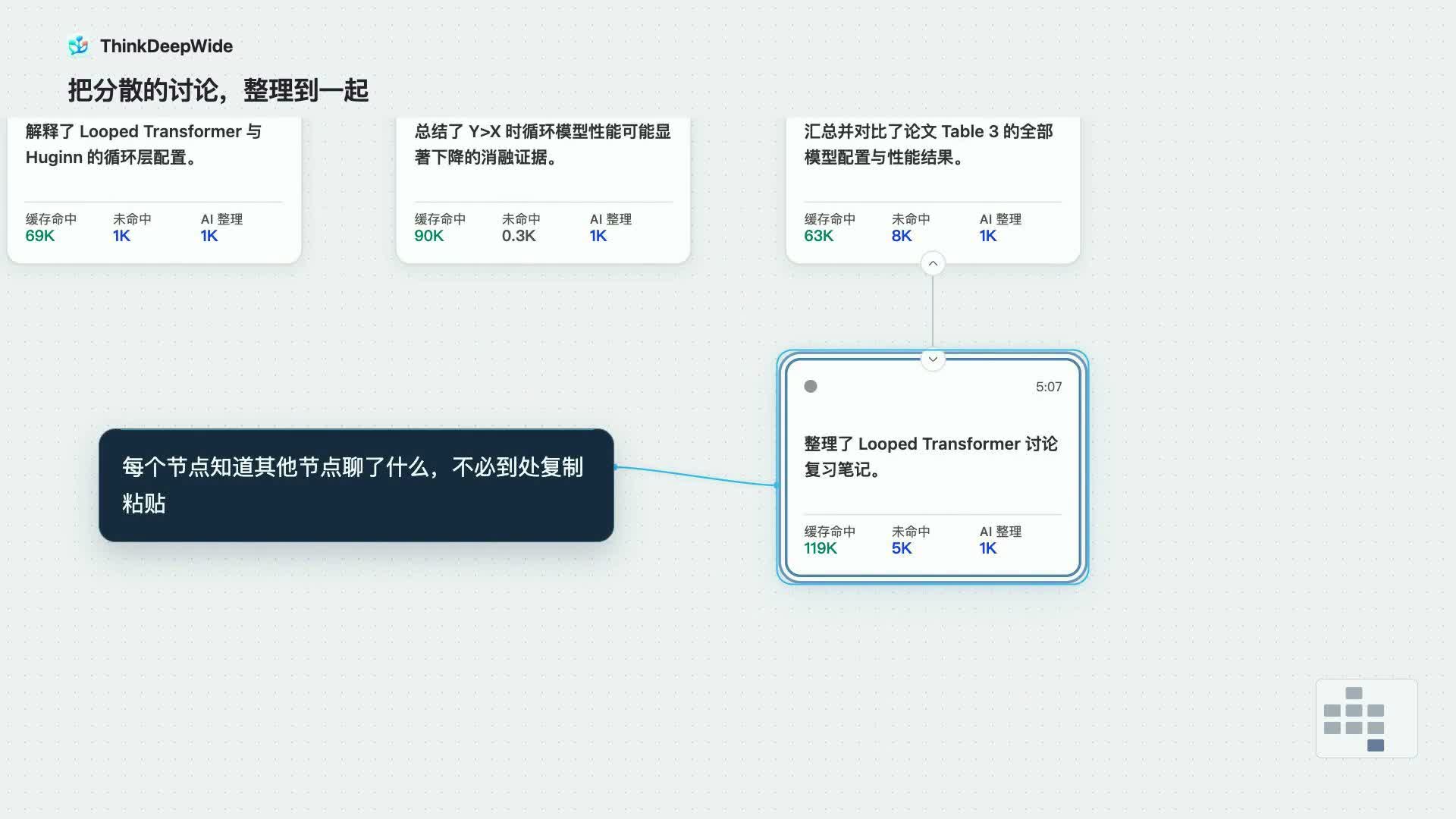
When you continue from a node, the discussion leading up to it provides the history for that branch. You do not have to explain the earlier questions again each time.
You can also bring material from other branches into the current discussion through cross-node references, then pull it together into notes. That does not mean sending every branch in full with every message, or that AI can never miss anything.
Yes. You can use it to read a paper, learn a new concept, think through a proposal or discuss material you have saved on your computer. Give your questions their own branches and keep asking about the parts you do not understand.
When you get to “Can we try this?”, you can ask it to read files, run code or write a document. It is an agent, so it can do more than chat with you.
No. A tree does not automatically make AI’s answers correct. What it does is make it easier to ask “Why do you think that?”, “Where is the original source?” or “Can we write some code to check?”, and investigate one claim on its own. We want to help you keep using your own judgment, not become more comfortable accepting every answer.
Currently, only Codex / Grok coding plans are supported. Connect your existing account to use your plan. You do not need to buy another set of tokens just because you switch to ThinkDeepWide. Your plan’s usage limits still apply. Connecting a model through an API key is not supported yet.
The ThinkDeepWide subscription pays for this product and is separate from your model service. Purchasing through this website is not open yet.
Our account and licensing service does not receive your conversation text, project files or model-account credentials. Your discussions and projects are stored on the computer you use or the remote host you connect.
When you ask AI to read a file or answer a question, relevant content is sent to your chosen model or tool service as part of that request. This is not a fully offline local model. Working on your computer does not mean that no data ever leaves it.
Yes. Connect your own Linux host over SSH to read files, run commands and keep discussing the remote project. You use the same tree interface while the project and tasks run on the host you choose; you do not have to move the whole project to your computer first.
Yes. You can copy or export the path from the root to your current node as Markdown, or export the whole conversation tree with its branch content and relationship index.
You can also export a path as a native session for the matching Codex / Grok tool and continue using it there. Your discussions should not be stuck inside our interface.
See the download section for available platforms. Linux is supported as an SSH host, with no Linux desktop app.